Tagged: operations
AI Is Moving Crazy Fast. That’s Not the Job.
Every week there is a new tool, a new skill pack, a new harness, a new framework, a new agent demo, a new thing we are all supposed to stop and care about. I get why people are excited. I am too. But the excitement and the job are not the same thing, and I keep watching teams confuse them.
Here is where I keep coming back to. If a change does not help us operate better, there is no real incentive to adopt it. Novelty is not an operating strategy.
We are already working with frontier harnesses. We can build our own tools and skills internally when they improve how we operate. If some hyped feature is actually useful, the frontier platforms will probably absorb it anyway. Just look at the OpenClaw. Not even 3 months and features started coming online. If the frontier does not respond to a valuable feature, and it is viable for the business, we can ask our harness to help us build it.
So I am less interested in your new harness, your skill pack, or your custom tool by itself. I am interested in whether it improves the operation. This is not to say that I won’t adopt a new tool or skill pack. I will. But I want to see the proof that it made the system better, not just faster at doing the same thing.
Let me give you a specific example. Anthropic just had to pull Fable 5, their Mythos class model. The government classified the class as a security risk and blocked foreign nationals from using it. Anthropic employs foreign nationals, so the whole model went dark.
Now imagine you had already wired Fable 5 into the core of your operation because it was the newest and most capable thing on the table. Today it is gone, and you are not improving anything. You are reworking everything.
That is the bill for treating the newest model as a strategy. The capability was real. The dependency was the mistake.
That is where AgenticOps matters to me, and it is not as another AI wrapper or another chat window. Chats are fun, but proactive value is the game. The goal is action. The goal is a system that can understand the work, find the next useful move, propose it, execute bounded tasks when allowed, generate evidence, and improve the loop over time.
More Movement Is Not the Same as Better
The Block engineering team is interesting to me for this reason. In AI-Assisted Development at Block they report real adoption numbers. AI-authored code jumped 69 percent in three months, automated pull requests went up 21 times, and about 95 percent of their engineers use AI in their daily work.
Those are serious velocity numbers, and they earned them. I am not knocking them. I am asking what they prove.
But I want to challenge my own excitement here, because velocity is the easy half. More pull requests and more AI-authored code tells you the movement increased. It does not tell you the system got better.
You can ship faster and break more. You can generate more and understand less. More movement is not enough. You need to know if the movement made the system better or just made noise faster.
That is why the measurement I trust most lives on the quality side, not the volume side. The DORA metrics have spent years pointing at this. Lead time for changes, change failure rate, and the time it takes to recover when something breaks.
Those numbers tell you whether faster also meant safer. The honest scorecard is not “we used AI.” It is changes per contributor next to incident rate after production changes, sitting in the same view, so you cannot celebrate one while hiding the other.
The data inside the domains where an agentic system operates is the real asset. Code, issues, customer requests, delivery flow, incidents, approvals, policies, invoices, support history, decisions, exceptions, outcomes.
That is not just context for a prompt. That is the operating graph of the business. The opportunity is not to throw a chat window at it. It is to run governed loops on top of it and measure what changed.
Why “Loop Everything” Is the Wrong Goal
Now, the fantasy version of this is “AI everywhere running the whole company.” I do not believe that future, and I think chasing it is how good teams waste a year. Most businesses cannot do that. Some should not even try. The strategy is not loop everything. The strategy is knowing where loops belong.
A lot of work still depends on human connection. Sales, leadership, customer trust, hard conversations, negotiation, care, judgment. AI can prepare, summarize, coach, detect risk, draft the follow-up, and surface the opportunity, but the relationship is still human.
A lot of work is regulated. Finance, health, legal, education, employment, insurance, lending, compliance. Those domains need permissions, evidence, audit trails, review gates, policy, and accountability. An agent taking action without governance is not innovation. It is a future incident report.
And a lot of business still happens in the physical world. Restaurants, construction, logistics, healthcare delivery, field service, manufacturing. Unless the robots are ready for that environment, agents are not doing the physical work.
They can coordinate it, inspect the evidence, schedule it, route it, document it, and warn people when something is off. That is real value. It is not magic, and pretending it is magic is how trust gets burned.
So the human is not out of the loop. The human shifts to the right part of the loop. Sometimes the human approves every action. Sometimes the human monitors the loop.
The human is also still to the left of the loop, but the loop is doing the work. Sometimes the human sets the goals, policies, and risk limits and lets it run. Sometimes the human handles the edge where trust, judgment, emotion, ethics, and physical reality decide the outcome.
The question AgenticOps should answer is not “can the agent do this.” It is “what is this agent allowed to do here, and who is watching.”
Place the Loop, Then Prove It
That gives you a small set of placements for any loop. An agent can observe, propose, act with approval, act inside bounded limits, hand off to a human, or stop. Most of governance is just deciding which one applies where, and writing it down so the system enforces it instead of hoping people remember.
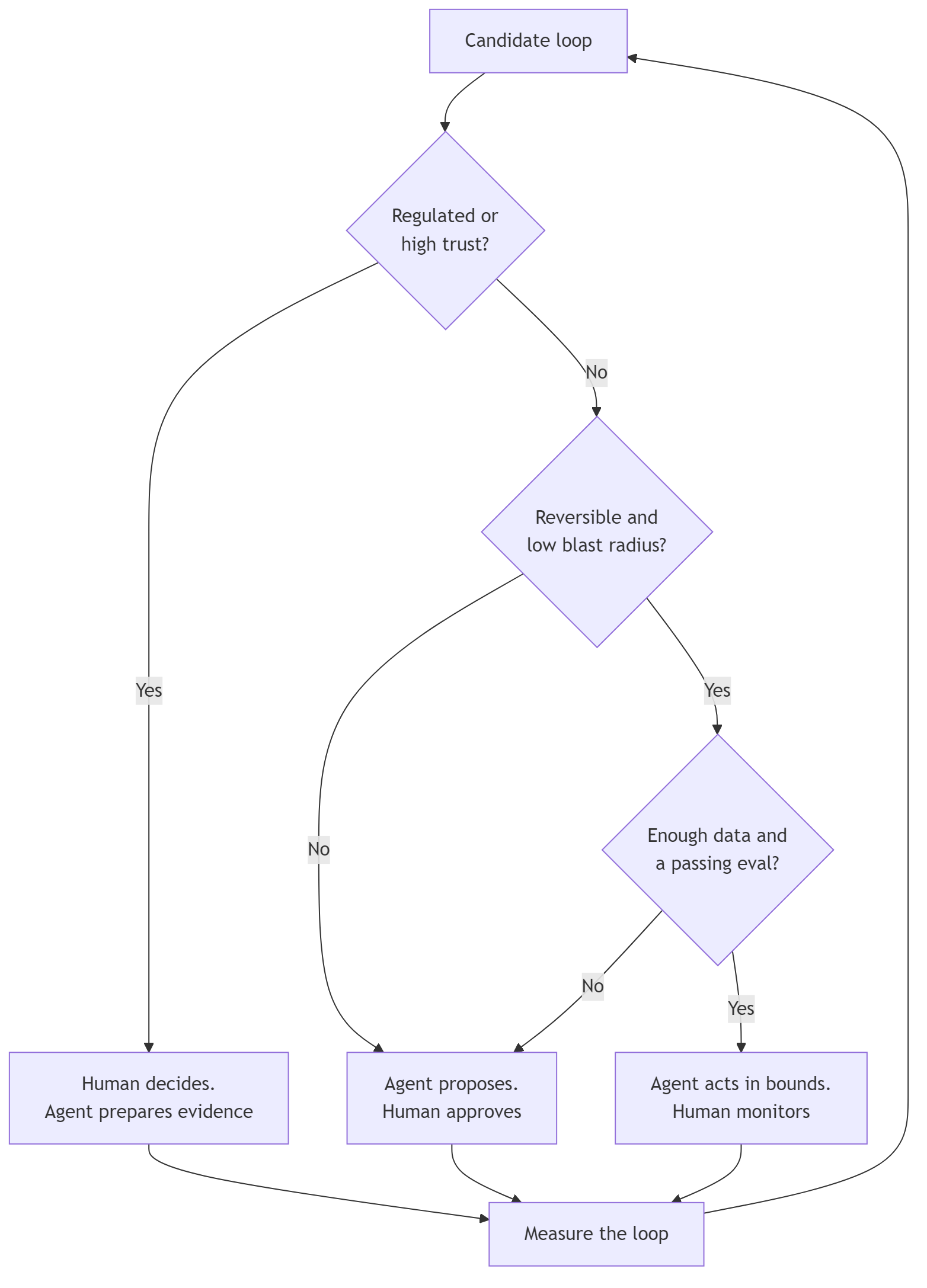
Start with the boring loops, not the demo-friendly ones. Production change review. Incident intake. Support triage. Sales follow-up. Delivery governance. Compliance evidence. Billing leakage. QA intelligence.
Pick the work that happens often, creates delay, has enough data, and can actually be measured. The boring loops are where the time is trapped, and they are where the evidence already exists to prove whether the loop helped.
Then prove it. Run the change against a scorecard before you call it a win:
- Did lead time improve?
- Did incident rate go down after production changes?
- Did the evidence behind decisions get better?
- Did humans accept the recommendations, or override them?
- Did rework drop?
- Did customers get a better outcome?
- Did we reclaim time from low-value work?
If the loop cannot answer those, it is not done. It is a demo.
This is the same discipline as How Agents Stay in Bounds, where containment is infrastructure and not a policy memo, and the same lesson as Autonomy Without Infrastructure Is Just a Demo. The agent was never the impressive part. The placement, the gates, and the scorecard are.
The Lane
I do not want AI theater. I do not want a pile of disconnected agents. I do not want a company chasing every release note from the frontier labs.
I want a governed operating system for agentic work. One that helps the business understand where autonomy belongs, deploys those loops safely, and proves the operation got better.
That is why I think every serious business should be building toward an AgenticOps system now. Not because AI is trendy. Not because agents are cool.
Because operations are full of repeatable loops that are slow, under-measured, and trapped in people’s heads. The work is finding those loops, placing each one where it belongs, and putting a number next to it.
That feels like the lane.
Let’s talk about it.
Autonomy Without Infrastructure Is Just a Demo

