Tagged: AgenticOps
Codify How You Work
You don’t build an agent by thinking about agents. You build an agent by thinking about how you do work.
Your ability to multiply your output begins with a simple discipline: take the skills locked in your head and turn them into structured, repeatable workflows. This is the starting point for all operational leverage. This is the kernel the entire system will be improved on.
The Way
When you codify how you work, you give yourself a system that can multiply your output and scale across projects, teams, and tools. You create clarity about how decisions get made, how work begins, how it moves, and how it completes. This is the foundation for any AgenticOps system you may build later.
But at this stage, the focus is only on you and the real place you get work done.
Establishing structure creates surface area for improvement. Improvement reduces waste. Waste reduction compounds over time.
This is the quiet logic behind AgenticOps: you externalize your way of working, let the system run your way as is. Then observe the friction and reduce waste where it naturally accumulates. You are not inventing efficiency. You are uncovering it and optimizing it away.
The Problem
Most people never write down how they work. They assume it is too complex, too obvious, or too personal to articulate. Some worry that codification leads to replacement. Some worry that it is tedious or unnecessary.
These fears result in the same outcome. The process remains invisible, so it cannot be measured, analyzed, improved, shared, or extended. Its hard to multiply if you can’t see what to multiply.
Then there are people that write down how they want to work instead of how they work today. Premature optimization is a trap. Clarity first. Compression later.
Solution Overview
The DecoupledLogic way is to treat your workflow and the workflow data as the most valuable operational asset you have. Before any optimization or automation is possible, we capture the real way you move through work. Not the theoretical model. Not the cleaned-up version. Not the one you wish you followed. The one you actually practice when no one is watching.
How you orient yourself. How you define what matters. How you locate the boundaries. How you identify the first irreversible decision. How you choose what not to do. How you set priority and direction before you set pace.
This is the material the system will learn from. This is the kernel it will grow from.
How It Works
All work follows a simple cycle: Start > Work > End. Input > Process > Output. This canonical sequence never changes. It is one of the few timeless rules in operational thinking.
Within the loop there are deeper patterns that matter.
Getting ready
This is how you select the next thing to work on. How you prioritize. How you set a target or goal. How you define the expected outcome and your stopping point. How you establish your north star. This is also where you gather context, align resources, and prepare your operational environment. Getting ready is not passive. It is an active decision about where your attention is going and why. This could be a simple 10 second though, don’t make it overly deep.
Starting the work
This is how you signal the start of the task. How you initiate the first meaningful action. How you reduce uncertainty enough to move forward. How you commit to the direction you set in the previous step. Starting is not the same as preparing. It is the moment you choose momentum over deliberation and take the first step out of the starting blocks.
This is the first move. And that first move is the kernel the entire system will be built on.
Working in flow
This is how you break down the problem. How you evaluate options and make decisions. How you measure progress while you are inside the work. How you prevent stalls and maintain forward motion. This is where your thinking style creates the most value and where codification has the greatest impact.
Ending the work
This is how you decide something is complete. How you package, deliver, publish, or hand off. How you create closure and free cognitive space for the next cycle. Ending well is as important as starting well because it defines what counts as done.
Reviewing the work
This is how you assess quality. How you reflect on what happened. How you identify improvement targets. How you reset for the next iteration of a cycle.
Cross-cutting functions
These patterns show up at every stage. How you communicate the work. How you measure the work. How you improve the work. These are not separate steps. They shape the entire cycle from beginning to end.
You already do all of this consciously or subconsciously. Codification is simply making it visible.
Impact
Once your workflow is explicit:
- You gain clarity about your own method
- You reduce waste because you can see where energy leaks
- You create a pattern others can follow without confusion
- You unlock automation and agents that actually reflect how you work
- You build a system that can multiply your output and evolve with you, not around you
A system is only as strong as its kernel. An agent is only as good as the pattern it learns from. And a workflow can only be optimized once the work itself has been made visible.
Start
Do not start building agents by thinking about agents. Start by thinking about how the work is done.
Write down your beginning, your flow, your completion, and your review. Capture your real process in the real place that work gets done. Let the existing system reflect back how it works. Then reduce the waste you can now see in the reflection.
Once the process exists outside the head of the people doing the work, the path to optimization becomes straightforward. Start with how you work.
If you want, we can codify your workflow together and create your first operational blueprint to begin improving how you work in the agentic age.
Let’s talk about it.

Meet /llms.txt: The AI-First Treasure Map Every Site Needs
This started as a small post that ballooned as I dug in and had more questions. You can give this post to your AI buddy or NotebookLM to have a discussion about how to win in Web X.0.
I am on a journey to transform from an enterprise software developer into an AI Engineer. Additionally, I am becoming an AgenticOps Operator. I’m learning so much. I’ve said it before on this blog that the way we consume the internet is changing. AI agents are increasingly taking over how we consume the internet. They provide us with relevant and curated content without us having to leave the chat UI. That means that businesses need to rethink SEO to attract these agents if they want to reach us.
Imagine giving ChatGPT, Claude, or Perplexity an LLM focused sitemap highlighting exactly where your site’s most valuable content lives. That’s the growing power of /llms.txt, the latest practice borrowed from SEO, but made specifically for large-language models (LLMs).
Why /llms.txt Matters
AI tools like ChatGPT don’t pre-crawl your entire site; they pull pages in real-time, often burning valuable context window space on ads, nav bars, and irrelevant HTML elements. This inefficiency leads to missed content and inaccurate AI-generated answers. Enter /llms.txt: a concise, Markdown-formatted “treasure map” guiding LLMs directly to your high-value content.
I’m not saying this is the answer or that it will solve LLM search results for your website, but this is a start and a move in the right direction that doesn’t take a huge budget to experiment with.
A Quick History
The /llms.txt concept kicked off when Jeremy Howard (Answer.ai) proposed it in September 2024. Mintlify boosted its popularity, auto-generating /llms.txt files for thousands of SaaS documentation sites. Soon, Anthropic adopted the format, sparking broader acceptance across AI and SEO communities.
What Does /llms.txt Look Like?
Here’s a minimal example:
# Project Name

> A clear, concise summary of your site’s purpose.

## Core Docs

- [Quick Start](https://example.com/docs/quick-start): Installation and basic usage.

- [API Reference](https://example.com/api): Comprehensive REST and webhook documentation.

## Optional

- [Changelog](https://example.com/changelog): Latest updates and release notes.
Each heading creates a clear hierarchy, with short descriptions guiding AI directly to the content you want featured.
Here is a more complete version – https://www.fastht.ml/docs/llms.txt.
DIY or Automate?
Creating /llms.txt is straightforward:
- Choose 10-20 golden pages covering your most critical content.
- Write concise descriptions (no keyword stuffing needed).
- Host it at https://your-domain.com/llms.txt.
If you’d rather automate:
- Plugins like the WordPress LLMs-Full.txt Generator or tools like Firecrawl and Mintlify CLI simplify the process, ensuring your map stays fresh.
Here’s an easy way to start building your /llms.txt today. Give your favorite LLM chatbot (ChatGPT, Claude, Gemini…) links to the pages you want to list on your website. Provide it with a link to https://decoupledlogic.com/2025/07/28/meet-llms-txt-the-ai-first-treasure-map-every-site-needs/ and and https://llmstxt.org/ to provide it with context on /llms.txt. Then ask it to “create an llm.txt file for our website”, and see what you get.
Then submit your /llms.txt to https://directory.llmstxt.cloud/, https://llmstxt.site/, and llmstxthub.com.
Good Practices Checklist
- Limit your list to fewer than 25 high-value links.
- Avoid redirects or query parameters.
- Provide helpful, readable summaries, not keywords.
- Include only reliable, versioned content.
- /llms.txt isn’t private, use robots.txt alongside it for protection.
Early Results & Adoption
As of mid-2025:
- Prominent sites are actively maintaining /llms.txt and the list is growing
- Popular SEO plugins like Yoast and Rank Math now support it.
- Tools like LangChain and Cursor demonstrate significant improvements in AI citation accuracy.
- We are very early and all of this may change if Google decides to jump into this space.
How Do LLMs Discover /llms.txt?
This was my biggest question when I heard about /llms.txt. Here’s what I understand.
Currently, there’s no standardized automatic discovery for /llms.txt like there is for robots.txt or sitemap.xml. Instead, LLMs primarily discover /llms.txt through manual or indirect methods:
Current Discovery Methods
- Manual Submission:
- You explicitly feed your
/llms.txtURL to AI agents like ChatGPT (Browse), Claude, Perplexity, or custom-built tools (Semantic Kernel, LangChain, LangGraph). - Typically, you’d provide the direct URL (e.g.,
https://your-site.com/llms.txt) for ingestion.
- You explicitly feed your
- Community Directories:
- Sites like directory.llmstxt.cloud, https://llmstxt.site/ and llmstxthub.com maintain lists of public
/llms.txtURLs. - LLM developers periodically index these directories.
- Sites like directory.llmstxt.cloud, https://llmstxt.site/ and llmstxthub.com maintain lists of public
- Integration with AI Platforms:
- Platforms like Mintlify, Firecrawl, or LangChain may ingest URLs proactively from known sources or integrations with SEO/LLM plugins.
Future Potential for Automatic Discovery
A standardized discovery process (like the established robots.txt approach) is likely to emerge as /llms.txt gains adoption:
- Root-level probing (
https://your-site.com/llms.txt) could become a default behavior for AI crawlers. - Inclusion in a sitemap (e.g., referencing
/llms.txtfrom yoursitemap.xml) could assist automated discovery.
Currently, these methods are under active discussion within AI and SEO communities.
Recommended Good Practices (Today)
- Explicitly share your
/llms.txtURL directly with the platforms you’re targeting. - Submit your URL to community directories (like directory.llmstxt.cloud) to improve visibility.
- Monitor emerging standards to adapt quickly once automatic discovery becomes standard.
How to Submit Your URL Directly to AI Tools?
1. ChatGPT (Browse with Bing)
- Open ChatGPT with Browsing enabled.
- Paste your URL with a clear prompt:
"Please read and summarize the key points from https://your-site.com/llms.txt"
2. Anthropic Claude or Perplexity
- Simply paste your URL directly into the chat and prompt clearly:
"Review our documentation here: https://your-site.com/llms.txt and answer any product-related questions based on it."
3. LangChain/LangGraph (Python Example)
- For API-based ingestion, use the following snippet:
from langchain.document_loaders import WebBaseLoader loader = WebBaseLoader("https://your-site.com/llms.txt") docs = loader.load() - Once loaded, your content is available for inference in your custom AI apps.
Quick-check: Is Your URL Ready?
- Paste your URL into any browser:
- It should directly show your markdown content (no login or redirects).
- Example success case:
# Company Documentation > Core Product Resources ## Essential Pages - [Getting Started](https://your-site.com/start): Quick onboarding steps.
How to Experiment with /llms.txt?
Here’s how your company can effectively experiment with /llms.txt to measure its real-world impact:
1. Define Clear Objectives
Start by specifying exactly what you want to achieve. Typical objectives include:
- Better AI-generated citations
- Increased discoverability of key content
- Improved user engagement via AI-driven channels
2. Choose Targeted Metrics to Track
Focus on measurable outcomes, including:
- Citations and backlinks from AI tools
- Organic traffic from AI-powered search results
- Changes in session duration or page depth from AI referrals
- Reduction in support queries due to better AI answers
3. Create and Implement a Test Version
Develop a concise /llms.txt:
- Select 10–20 high-value pages.
- Clearly label your content and hierarchy.
- Deploy it at the root:
your-domain.com/llms.txt.
Example structure:
# Company Name
> Your one-line value proposition.

## Core Content
- [Getting Started](https://your-domain.com/start): Setup & onboarding guide.
- [Product Overview](https://your-domain.com/product): Key features & use cases.

## Secondary Content
- [Knowledge Base](https://your-domain.com/kb): Common issues & solutions.
4. Baseline Measurement
Before releasing the /llms.txt publicly:
- Capture existing traffic metrics from AI-generated citations.
- Document current quality of AI-generated summaries and answers referencing your content.
5. Launch Your Experiment
Share your /llms.txt URL manually with key inference-time agents to jumpstart discovery:
- ChatGPT (Browsing), Claude, Perplexity, Google AI Overviews, LangChain tools, etc.
(Automatic discovery isn’t standardized yet, so manual submission is essential.)
6. Monitor and Analyze Results
Regularly check (weekly or monthly) and add to reporting:
- Increases in AI-driven referral traffic
- Quality improvements in content citations by AI
- Enhanced accuracy in AI-generated summaries or Q&A referencing your site
- User behavior analytics from referrals (page views, bounce rates, conversions)
7. Iterate and Optimize
Based on your findings, adjust your /llms.txt strategy:
- Add or remove pages based on AI citation performance.
- Improve content descriptions to guide AI context better.
- Consider automation tools (like Mintlify CLI or Firecrawl) for frequent updates.
Common Pitfalls to Avoid
- Keep
/llms.txttight and precise. - Provide clear, succinct context—AI reads the prose carefully.
- Regularly update the file based on actual usage data.
The Bottom Line
Think of /llms.txt as your AI landing page, optimized to direct AI models straight to your best resources. Regularly updating this file with your release cycle boosts AI-driven engagement, accuracy, and visibility in an increasingly AI-first world. ASO (Agent Search Optimization) and similar concepts are becoming a thing and it’s a good time to start learning more about the coming changes to SEO and internet marketing.
Let’s talk about it.
Ready to implement your own AI-first treasure map? Starting your /llms.txt experiment today positions your brand ahead of the curve in optimizing AI-driven discovery and citation quality. Would you like support setting up measurement tools, or perhaps a sample /llms.txt tailored specifically for your site?
Want to dig in on it, let’s talk about. I’m always down to talking about all things AI, agents, and AgenticOps.

AgentOps: The Operational Backbone for AgenticOps
Why agents need their own control plane, and what we’re doing about it.
We’ve spent decades refining how to ship software safely. DevOps gave us version control, CI/CD, monitoring, rollback. Then came MLOps, layering on model registries, drift detection, pipeline orchestration. It’s all good.
But now we’re shipping something different: autonomous agents. Virtual coders that operate alone in their own little sandbox. They are a bunch of mini-me’s that code much better than me. However, they sometimes get lost and don’t know what to do. As a result, they will make things up.
We’re not just shipping code or models, but goal-seeking, tool-using, decision-making alien lifeforms. Beings that reason, reflect, and act. And many are shipping with zero visibility into what they’re doing after launch. I say give them agency but give them guardrails. Trust but verify.
I’ve been enjoying what I’ve been reading on the topic of AgentOps. I’m interested in how to bring valuable practices into our agent development. That’s where AgenticOps comes in. It’s not just DevOps with prompt logging. It’s been a year long thought exercise on how we operationalize agency in production.
What’s so different about autonomous agents?
A few things, actually:
- They improvise. Every agent run can take a new path. Prompts mutate. Goals shift.
- They chain tools and memory. It’s not one model, it’s a process graph across APIs, vectors, scratchpads.
- They’re hard to debug. When something goes wrong, you don’t just check logs. You need to replay reasoning.
- They cost money in real time. An agent stuck in a loop doesn’t just crash, it runs up a token bill that costs real money.
The DevOps playbook wasn’t built for this. Neither was MLOps. This is something new. AgentOps is cool, I love, it but I’ve been calling it AgenticOps and its my playbook.
So what is AgenticOps, really?
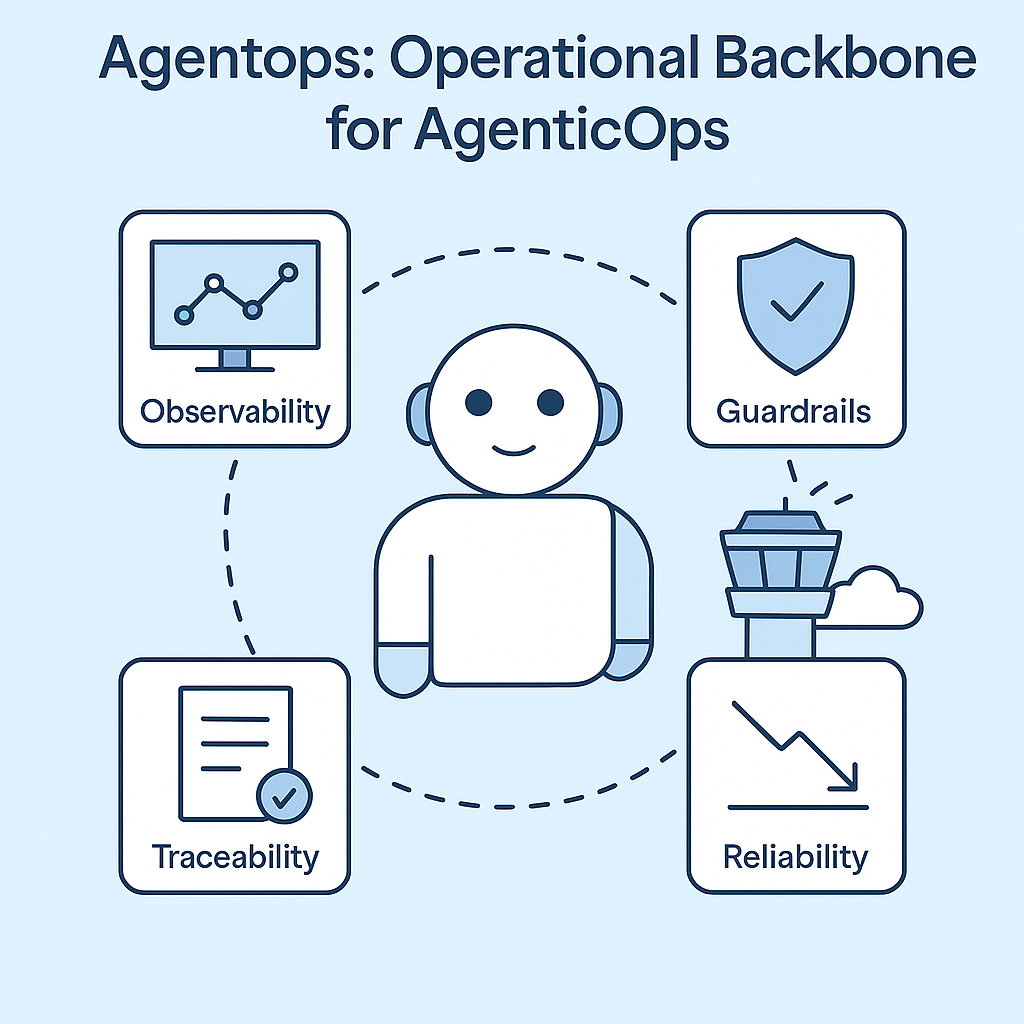
Think of AgenticOps as your mission control tower for autonomous systems. It’s how you keep agency productive, safe, and accountable at scale. These agents are like bad ass kids in a classroom sometimes. My wife is a teacher and she says my agents need routines and rituals and behavior strategies. They need AgenticOps
Here’s what AgenticOps adds to the stack that echoes what I’m seeing in AgentOps:
- Observability for agents
Live dashboards. Step-level traces. Session replays. You see what the agent thought, decided, and did, just like tracing a debugger. - Guardrails that matter
Limit which tools agents can access. Enforce memory policies. Break runaway loops before they eat your GPU budget. - Full traceability
Every prompt, tool call, response, and memory snapshot logged and queryable. Audit trails you can actually follow. - Reliability at runtime
Detect anomalies, hallucinations, cost spikes. Trigger alerts or pause execution if things go sideways.
This isn’t observability-as-a-service tacked onto ChatGPT. This is real operational scaffolding for agentic systems in production.
How it fits into your stack
If your life is shifting into AI Engineering, you’re probably already doing some mix of this:
- Using LangGraph, AutoGen, CrewAI, or your own glue
- Plugging in vector stores, APIs, function calls
- Deploying workflows with multiple agents and tools
An AgenticOps framework encompasses all that. It doesn’t replace it. Instead, it provides a plug-and-play layer to make it safe and visible.
It’s the runtime control layer that lets you:
- Version your agents and context
- Monitor them in action
- Understand what went wrong
- Rewind and fix without guesswork
And just like DevOps before it, AgenticOps will soon be table stakes for any serious deployment.
What you get from AgenticOps
Let’s talk outcomes:
- MTTR down: You can debug reasoning chains like logs. Find the bad prompt in seconds.
- Spend under control: Token usage is monitored and optimized. No more budget black holes.
- Safer autonomy: Guardrails catch weird behavior before it hits production.
- Compliance ready: Trace logs that tell a human story, useful for audits, explainability, and ethics reviews.
This isn’t hypothetical. This is already shipping to production.
Why I care about this
AgenticOps isn’t a buzzword. It’s the foundation that will make agents trustworthy at scale.
If we want autonomous systems to do real work, safely, reliably, transparently, we have to operationalize agency itself.
That’s what we’re building with AgenticOps. It’s our take, our lens, our direction, and how I think in this space.
Let’s talk about it.
If you want to build fast vibe coded prototypes, build alone. If you want to build stable, safe agentic systems for the long-term, build together.
If you’re building “bad ass agents” or agentic systems, I’d love to hear about it. Even if you’re just thinking about it, let me know what you’re running into. Want to play with it and explore together? Let me know. Share your repo and I’ll share mine – https://github.com/charleslbryant/agenticops-value-train.

Ubuntu Dev Environment Setup on Windows (WSL)
It’s been hard for me to sit back and watch everyone dig into Claude Code without me. This weekend I took a little time to get it installed and it was a journey. Claude Code doesn’t run native on Windows so I had to do some WSL magic. I want to write about Claude Code, but not write now. Let’s just say I’m not going back to Cursor, VS Code, Windsurf or Aider… I’m team Claude Code, until the next shiny thing distracts my attention.
Any way Ubuntu isn’t my thing so this was harder than it should be. Good thing we have these super intelligent machines at our disposal. I asked my AI assistant George to write an install guide. Below is what I got. This wasn’t as straight forward as the guide lays it out, but it wasn’t too hard to go back and forth with George to get everything up and running.
I am basically running Claude Code in Cursor running in Ubuntu. Fun times.
This guide walks you through installing and configuring a full-featured development environment using WSL, Ubuntu, and essential development tools. You’ll be ready to develop locally with Docker, Claude Code, Azure, GitHub, and more.
1. Prerequisites
- Windows 10/11 with WSL enabled
- WSL2 installed (wsl –install in PowerShell)
- A Linux distribution (we used Ubuntu 24.04)
- Terminal: Windows Terminal
2. Setup Folder Structure
mkdir -p ~/projectscd ~/projectsKeep all your development projects in this folder. Easy to back up, mount, and manage.
4. Git + GitHub CLI
sudo apt updatesudo apt install git gh -ygh auth loginUse gh to clone, create, and manage GitHub repos easily.
5. Node.js (via nvm)
# Install NVM (Node Version Manager)curl -o- https://raw.githubusercontent.com/nvm-sh/nvm/v0.39.7/install.sh | bash# Load nvm into current shell sessionexport NVM_DIR="$HOME/.nvm"source "$NVM_DIR/nvm.sh"# Verify nvm is availablenvm –versionnvm install --ltsnvm use –ltsnvm alias default 'lts/*'node -vnpm -v3. Claude Code + Cursor Setup
Install Cursor (AI coding editor)
In WSL Ubuntu:
cd ~/projectsmkdir my-project && cd my-projectcursor .Inside Cursor terminal, run:
npm install -g @anthropic-ai/claude-codeclaude doctorInside Claude run:
/terminal-setup/initIf Claude is stuck “Synthesizing” or “Offline”:
- Make sure Claude is signed in and internet is stable and you are working on a folder in Ubuntu not Windows
- Press Esc to cancel
- Restart Cursor and check Claude Code panel
6. .NET SDK
wget https://packages.microsoft.com/config/ubuntu/24.04/packages-microsoft-prod.deb -O packages-microsoft-prod.debsudo dpkg -i packages-microsoft-prod.debsudo apt updatesudo apt install dotnet-sdk-8.0 -y7. Azure CLI
curl -sL https://aka.ms/InstallAzureCLIDeb | sudo bashaz login --use-device-codeIf login doesn’t open a browser, copy the code and paste it at: https://microsoft.com/devicelogin
8. Docker CLI
Install Docker Desktop for Windows with WSL integration enabled.
In Ubuntu:
docker versiondocker context lsEnsure your context is set to desktop-linux if needed:
bash
docker context use desktop-linux
If permission denied on /var/run/docker.sock:
sudo usermod -aG docker $USERnewgrp docker9. Optional Dev Tools (Highly Recommended)
| Tool | Use Case | Install Command |
| make | Build automation | sudo apt install make |
| jq | JSON manipulation | sudo apt install jq |
| htop | Process monitor | sudo apt install htop |
| fzf | Fuzzy file finder | sudo apt install fzf |
| ripgrep | Fast file search (used by Claude) | sudo apt install ripgrep |
| tree | Directory visualizer | sudo apt install tree |
| redis-cli | Redis command-line | sudo apt install redis-tools |
| psql | PostgreSQL command-line | sudo apt install postgresql-client |
10. Azure Functions Core Tools
npm install -g azure-functions-core-tools@4 --unsafe-perm true11. Terminal Enhancements
Oh My Zsh (already installed if you ran /terminal-setup)
To fix re-opening setup prompt:
rm ~/.zshrc.pre-oh-my-zshAdd completions:
gh completion -s zsh >> ~/.zshrcaz completion >> ~/.zshrcsource ~/.zshrc12. Sync Windows Projects to Ubuntu (Optional)
rsync -avh /mnt/c/Users/YourName/path/to/project/ ~/projects/Final Checklist
| Area | Tools |
| AI Pairing | Claude Code + Cursor |
| Git Workflows | Git + GitHub CLI (gh) |
| Web Dev | Node.js, npm, nvm |
| C#/.NET | .NET SDK 8 |
| Cloud | Azure CLI + Functions Core |
| Containers | Docker + Desktop Integration |
| Data Access | PostgreSQL + Redis CLI |
| Dev Tooling | jq, htop, tree, ripgrep, fzf |
You’re done. You’ve got a complete AI-first, cloud-ready, full-stack dev environment right in your Ubuntu WSL.

Browser War III: The Rise of the AI Web
A New Battle Begins
The browser wars are back. First it was Netscape vs Internet Explorer. Then Chrome took on Firefox and swallowed Internet Explorer’s market share. Now we’re entering Browser War III, and this time, the battleground is intelligence.
AI is no longer just bolted onto browsers. It’s becoming the core experience. The new wave of contenders isn’t just adding chatbots. They’re building entire browsers around autonomous AI agents. The result: browsers that browse for you.
From Interface to Intelligent Assistant
Traditional browsers were built to load web pages. These new AI-first browsers are built to do things.
They summarize documents. They manage tabs. They finish tasks like booking flights, shopping, and writing content. These tasks are done not through extensions, but through embedded agents with full-page context.
Opera’s Neon browser calls itself agentic, capable of navigating the web and performing actions on your behalf. Perplexity’s Comet positions itself as an AI operating system, not just a search layer. The Browser Company’s Dia is rebuilding Arc from the ground up with AI multitasking. Brave’s Leo helps users instantly without sending data for training.
The key shift: these aren’t tools. They’re collaborators.
The Contenders are Lining Up
Multiple companies are now entering the AI-first browser race:
- OpenAI’s browser is built on Chromium and powered by ChatGPT. It keeps users inside a chat interface and directly competes with Chrome. Open AI hiring people who helped build Chrome makes sense now.
- Perplexity’s Comet integrates its AI search engine with tools that read pages, summarize content, manage workflows, and book things for users.
- Opera’s Neon promises both “Do” (task automation) and “Make” (content creation), reimagining the browser as an active assistant.
- Brave with Leo builds privacy-first AI features into its interface, allowing real-time assistance without data retention.
- Dia by The Browser Company focuses on multitasking and AI-native design, continuing Arc’s legacy while pushing toward full agentic capabilities.
Meanwhile, incumbents are adapting. Google has added generative AI to Chrome and launched an AI-powered search mode. Microsoft continues to embed Copilot deeper into Edge. It’s getting hot in here.
Why It Matters
If AI browsers succeed, they won’t just replace your browser. They’ll replace how you interact with the internet.
Imagine this future:
- No more ten-tab rabbit holes
- No more hunting for links
- No more manually filling out forms or searching product reviews
Instead, you prompt your browser. It understands. It acts.
This could flip the digital economy. Publishers already report falling traffic as AI bots, not humans, consume content. Search becomes less important if users just ask their browser agent. Ads become less visible if browsing happens behind the scenes. Even how people read news or shop online may shift. I
A report from the Reuters Institute found that younger users are increasingly getting news from AI chatbots, not websites. Platforms like Opera Neon now claim they can generate images, translate voice, and write entire reports, all from a single prompt. This is about more than speed or simplicity. It’s a new paradigm for web interaction.
I’ve been on my soapbox shouting how we need to learn how to market and optimize for agents, they’re coming.
Why It Might Stall
There’s also good reason to stay grounded. And get off my soapbox.
Most people don’t switch browsers easily. Chrome has over 60 percent market share. Habits are sticky. And the early experience with some AI browsers shows that they still stumble.
Perplexity’s Comet, for instance, was impressive on simple tasks but failed on more complex actions, according to early TechCrunch reviews. Privacy remains a concern. These tools often ask for deep access to calendars, email, or documents, which can be a tough sell.
There’s also the risk of hallucinations and automation mistakes. And if every company builds their own AI agent, users might be overwhelmed, not empowered.
Big Tech won’t sit still. Google will copy features that work. Microsoft already has the distribution power to push Copilot across Windows and Edge.
And then there are the regulators. The DOJ is already targeting Google’s browser dominance. GDPR and CCPA are tightening the rules around data access and retention. Any AI browser hoping to scale must navigate this legal minefield.
A Slow Shift or a Seismic One
The future of browsers may not flip overnight. But the trajectory is clear. AI is no longer a side feature. It’s becoming the foundation.
For now, early adopters and power users will lead the charge. But the potential is significant. If these tools get good enough to reliably perform tasks, not just surface content, the way we use the web will change.
We’re not just watching a browser war. We’re watching a transformation in how humans and machines work together online.
Whether this becomes the dominant model or fades into niche use depends on what happens next. But the ambition is clear. In Browser War III, the question isn’t which browser loads faster. It’s which one thinks and acts better.

Background Agents in Cursor: Cloud-Powered Coding at Scale
Build Faster with Cloud-First Automation
Imagine coding without ever leaving your IDE, delegating repetitive tasks to AI agents running silently in the background. That’s the vision behind Cursor’s new Background Agents, a new feature that brings scalable, cloud-native AI automation directly into your development workflow.
From Local Prompts to Parallel Cloud Execution
In traditional AI pair-programming tools, you’re limited to one interaction at a time. Cursor’s Background Agents break this mold by enabling multiple agents to run concurrently in the cloud, each working on isolated tasks while you stay focused on your core logic.
Whether it’s UI bug fixes, content updates, or inserting reusable components, you can queue tasks, track status, and review results, all from inside Cursor.
Why This Matters
Problem: Manual Context Switching Slows Us Down
Every time we need to fix layout issues, update ads, or create pull requests, we context-switch between the browser, editor, GitHub, and back.
Solution: One-Click Cloud Agents
With Background Agents, we:
- Offload UI tweaks or content changes in seconds
- Automatically create and switch to feature branches
- Review and merge pull requests without leaving the IDE
It’s GitHub Copilot meets DevOps, fully integrated.
How It Works
- Enable Background Agents under Settings → Beta in Cursor.
- Authenticate GitHub for seamless PR handling.
- Snapshot your environment, so the agent can mirror it in the cloud.
- Assign tasks visually using screenshots and plain language prompts.
- Review results in the control panel with direct PR links.
Each agent operates independently, meaning you can:
- Fix mobile UI bugs in parallel with adding a new ad card.
- Update dummy content while another agent links it to a live repo.
Keep tabs on multiple tasks without blocking your main flow.
Note: This is expensive at the moment because it will use the Max Mode.
The Impact: Focus Where It Matters
- 🚀 Speed: Complete multi-step changes in minutes.
- 🧠 Context: Stay immersed in Cursor with no GitHub tab juggling.
- 🤝 Collaboration: Review, update, and deploy changes faster as a team.
What’s Next?
The Cursor team is working on:
- Auto-merging from Cursor (no GitHub hop)
- Smarter task context awareness
- Conflict resolution across overlapping branches
Is this is the future of development workflows, agent-powered, cloud-native, and editor-first?
Try It Out
Enable Background Agents in Cursor and assign your first task. Start with a UI fix or content block update and see how you like it. Just remember that this service uses Max Mode and is expensive so be careful.
If you are looking to improve your development workflow with AI, let’s talk about it.

Enterprise SaaS is Broken. AI Agents Can Fix It.
Let’s talk about enterprise software.
Everyone knows the dirty secret: it’s complex, bloated, slow to change, and ridiculously expensive to customize. It’s a million dollar commitment for a five-year implementation plan that still leaves users with clunky UIs, missing features, and endless integration headaches.
And yet, companies line up for enterprise software as a service (SaaS) products. Why? Because the alternative, building custom systems from scratch, can be even worse.
But what if there was a third way?
I believe there is. And I believe AgenticOps and AI agents are the key to unlocking it.
The Current Limitation: AI Agents Can’t Build Enterprise Systems (Yet)
There’s a widely held belief that AI agents aren’t capable of building and maintaining enterprise software. And let’s be clear: today, that’s mostly true.
Enterprise software isn’t just code. It’s architecture, security, compliance, SLAs, user permissions, complex business rules, and messy integrations. It’s decades of decisions and interdependencies. It requires long-range memory, system-wide awareness, judgment, and stakeholder alignment.
AI agents today can generate CRUD services and unit tests. They can refactor a function or scaffold an API. But they can’t steward a system over time, not without help.
The Disruptive Model: Enterprise System with a Core + Customizable Modules
If I were to build a new enterprise system today, I wouldn’t sell build a monoliths or one-off custom builds.
I’d build a base platform, a composable, API-driven foundation of core services like auth, eventing, rules, workflows, and domain modules (like claims, rating engines, billing, etc. for insurance).
Then, I’d enable intelligent customization through AI agents.
For example, a customer could start with a standard rating engine, then they could ask the system for customizations:
> “Can you add a modifier based on the customer’s loyalty history?”
An agent would take the customization request:
- Fork the base module.
- Inject the logic.
- Update validation rules and documentation.
- Write test coverage.
- Submit a merge request into a sandbox or preview environment.
This isn’t theoretical. This is doable today with the right architecture, agent orchestration, and human-in-the-loop oversight.
The Role of AI Agents in This Model
AI agents aren’t building without engineers. They’re replacing repetition. They’re doing the boilerplate, the templating, the tedious tasks that slow innovation to a crawl.
In this AgenticOps model, AI agents act as:
- Spec interpreters (reading a change request and converting it into code)
- Module customizers (modifying logic inside a safe boundary)
- Test authors and validators
- Deployment orchestrators
Meanwhile, human developers become:
- Architects of the core platform
- Stewards of system integrity
- Reviewers and domain modelers
- Trainers of the agent workforce
The AI agent doesn’t own the system. But it extends it rapidly, safely, and repeatedly.
This Isn’t Just Faster. It’s a Better Business Model.
What we’re describing is enterprise software as a service as a living organism, not a static product. It adapts, evolves, and molds to each client’s needs without breaking the core.
It means:
- Shorter sales cycles (“Here’s the base. Let’s customize.”)
- Lower delivery cost (AI handles the repetitive implementation work)
- Faster time to value (custom features in days, not quarters)
- Higher satisfaction (because the system actually does what clients need)
- Recurring revenue from modules and updates
What It Takes to Pull This Off
To make this AgenticOps model work, we need:
- A composable platform architecture with contracts at every boundary (OpenAPI, MCP, etc.)
- Agents trained on domain-specific architecture patterns and rules
- A human-in-the-loop review system with automated guardrails
- A way to deploy, test, and validate changes per client
- Observability, governance, and audit logs for every action an agent takes
Core build with self serve client customizations.
AI Agents Won’t Build Enterprise Software Alone. But They’ll Change the Game for Those Who Do.
In this vision, AI Agents aren’t here to replace engineers. In reality, they may very well replace some engineers, but they could also increase the need for more engineers to manage this agent workforce. Today, AI Agents can equip engineers and make them faster, freer, and more focused on the work that actually moves the needle.
This is the future: enterprise SaaS that starts composable, stays governable, and evolves continuously to meet client needs with AI-augmented teams.
If you’re building this kind of Agentic system, or want to, let’s talk about it.

Execution is Everything: Building an AgenticOps Playbook That Works
Ideas are easy; execution is the hard part.
We’ve all seen great strategies gather dust simply because the path from planning to action wasn’t clear. The problem isn’t always the ideas or the people, often, it’s the absence of a structured playbook for execution.
When execution falters, it’s usually due to unclear roles, inconsistent processes, or poor communication. Over the years, I’ve seen firsthand how these issues erode momentum and hinder even the most talented teams.
A practical playbook addresses these pitfalls directly. It documents not just what needs to be done, but also how to do it consistently, who is responsible at each step, and why it matters. Clear processes remove guesswork, improve collaboration, and make execution repeatable and scalable.
But a good playbook isn’t rigid. It’s a living document, evolving as teams learn and conditions change. Regularly scheduled feedback loops ensure continuous improvement, allowing the team to adapt swiftly and effectively.
Recently, I’ve been exploring the idea of “Playbooks as Code,” inspired by the concept of infrastructure as code. Infrastructure as code allows teams to provision and manage cloud resources through scripts, ensuring consistency, measurability, and testability. Similarly, implementing playbooks as automated workflows, using tools like Microsoft Power Automate or Zapier, lets us codify execution steps. This approach transforms a documented playbook into a deployable, executable workflow, initiated at the push of a button. It ensures consistent, measurable, and testable workflows, significantly enhancing reliability and efficiency.
If you’re finding your team struggles to turn strategic intent into results, consider whether your execution clarity matches your strategic clarity. Building a detailed, flexible execution playbook, and perhaps exploring playbooks as code, might just be the most impactful thing you do this year.
What’s been your experience with execution playbooks or automated workflows? I’d love to learn from your insights. If you want to build one with me, let’s talk about it.

Aligning Client Goals with User Needs: It’s Not Either-Or
The balancing act between what clients (product owners) want and what users need isn’t easy, but it doesn’t have to be a trade-off. Often, teams feel torn prioritizing client objectives for quick wins or leaning heavily into user needs for long-term satisfaction. But true strategic clarity comes from aligning these perspectives, not choosing between them.
Think about it, clients seek measurable outcomes, whether it’s revenue, market share, or operational efficiency. Users, meanwhile, value intuitive experiences that genuinely solve their problems. Misalignment can lead to products that look good on paper but fail in practice.
In retrospect, I’ve learned through experience that the secret lies in embedding user-centric design into strategic planning from day one. When users’ needs directly inform business objectives, something powerful happens, products resonate deeply, adoption grows, and client goals naturally follow.
This isn’t theoretical, it’s practical wisdom. By clearly documenting how each feature, action, or decision maps to both client objectives and user needs, ambiguity fades. Teams make better decisions faster because they have a north star guiding every step.
Ultimately, strategic clarity isn’t about compromising or pleasing everyone superficially. It’s about achieving alignment that creates genuine, sustainable value for all stakeholders involved.
Applying this concept to AgenticOps is critical, especially given widespread uncertainties around the value, safety, and trustworthiness of AI among clients and users. Establishing clear, transparent strategies early in the process can significantly influence the success or failure of an AgenticOps implementation.
What’s your approach to balancing these needs? I’d love to hear your thoughts, let’s talk about it.

AgenticOps: From Strategy to Continuous Improvement
Have you ever had a great idea fall flat during execution? Or found your team stuck between prioritizing client demands and user needs? Perhaps you’ve struggled with chaos in data management or wondered how to effectively measure and improve performance. These challenges aren’t unique I’ve encountered and wrestled with them too.
That’s why I’m writing a series on AgenticOps as a collection of insights and experiences aimed at navigating the complex world of product strategy, execution, technical workflow planning, disruptive marketing, and continuous improvement.
Throughout this series, we’ll explore AgenticOps and:
- Strategic clarity and how aligning client goals and user needs can drive powerful outcomes.
- Using execution playbooks to turn great strategies into actionable and consistent results through clear roles, processes, and “playbooks as code.”
- Intelligent workflow architecture and managing data complexity with adaptive, AI-driven workflows.
- Disruptive go-to-market strategies is interesting because AI is going to disrupt more than markets. I think bold disruption is essential for impactful market entries for AI first companies and reentry for incumbents retooling with AI.
- Continuous improvement systems as robust measurement systems that drive ongoing growth and improvement.
My goal with this series is not only to share what I’ve learned but also to start meaningful conversations. As I wrap my head around how to apply AI to business problems for clients in my day job, this is how I record my thoughts. If you are thinking about similar topics, I invite you to read, reflect, and share your experiences and insights along the way.
Stay tuned for the upcoming posts, and feel free to jump into the discussion at any time! I talk to AI too much, so I could use some human interaction.
 DecoupledLogic