Autonomy Without Infrastructure Is Just a Demo
The AgenticOps series defines six layers, four containment rings, and a maturity model. All of it was framework vision. The AgenticOps Applied series are stories about how the vison is realized through experiments and production case studies. This post is a case study that tests the framework against a production system that was built without the it.
What Stripe Published
Stripe released two blog posts in early 2026 describing their internal coding agents, called Minions (Part 1 and Part 2). The numbers are striking. Over 1,300 merged pull requests per week. Every PR is human-reviewed. None contains human-written code.
Stripe didn’t build Minions from a governance framework. They built them from engineering first principles to solve a production problem. Autonomous coding agents at scale inside a system that processes payments.
The architecture they arrived at is worth examining. Not because it validates AgenticOps by name, but because independent convergence on the same structural patterns is stronger evidence than any single implementation built from the framework itself.
What They Built
Five components define the Minions architecture.
Devboxes. Every agent run executes in a disposable AWS EC2 instance. These environments arrive pre-warmed with the full codebase, built dependencies, and running services in about ten seconds. No internet access. No production connectivity. Destroyed after each run. Stripe already used devboxes for human engineers. The same infrastructure worked for agents.
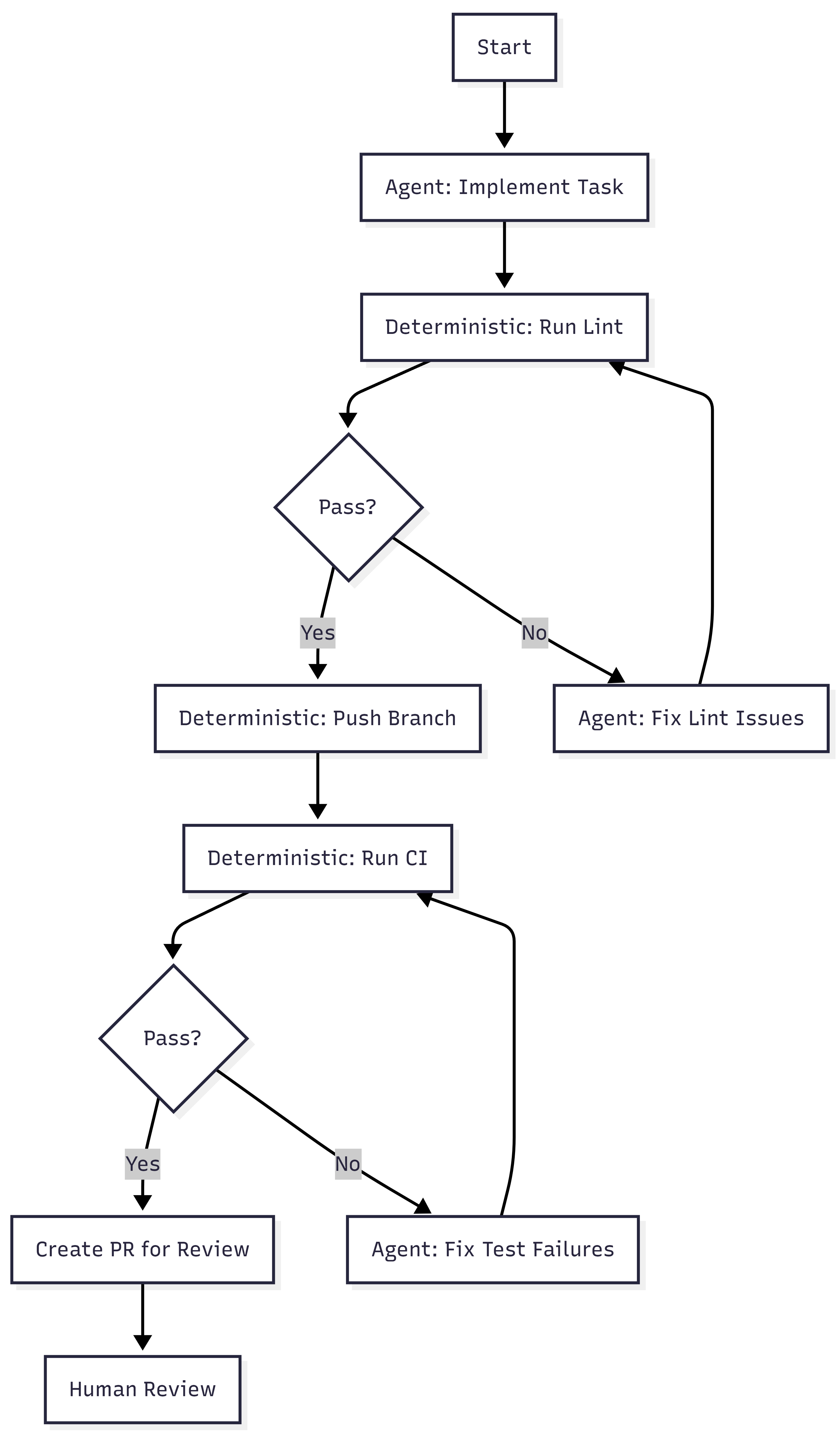
Blueprints. Minion runs are not pure agent loops. They are hybrid state machines that interleave deterministic nodes with stochastic agent nodes. Deterministic steps handle linting, pushing branches, and triggering CI. Agent steps handle implementation and failure resolution. The agent gets freedom where reasoning helps. The system enforces what must always happen.
Toolshed. An internal MCP server with nearly 500 tools for internal systems and SaaS platforms. Agents receive curated subsets, not the full set. Security controls prevent destructive actions. Before a run begins, the system fetches context from tickets and documentation so agents start informed rather than searching blind.
Rule files. Static guidance scoped to directories. As the agent traverses the codebase, relevant rules load automatically. Stripe standardized on Cursor’s format and syncs rules to support Claude Code as well. Global rules fill the context window. Scoped rules provide signal where the agent is actually working.
Verification pipeline. Local lint runs in under five seconds after generation. Only after that passes does the system target CI against a suite of over three million tests (WTF). If CI fails, the agent gets one retry. Not infinite retries. One. Then the PR goes to a human. Stripe caps iterations because compute, tokens, and time cost money.
Alignment to the Containment Rings
Post 4 of the main series introduced four rings. Here is where Stripe’s architecture maps.
| Ring | What It Requires | What Stripe Built |
| 1: Constrain Inputs | Curated tool access, scoped context | Toolshed (curated MCP subsets), directory-scoped rule files, pre-hydrated context |
| 2: Constrain Environment | Isolated, disposable execution | Devboxes (pre-warmed EC2, no internet, destroyed after use) |
| 3: Validate Outputs | Layered verification | Local lint (seconds) + selective CI (minutes) + capped retry (one attempt) |
| 4: Gate Promotion | Human review as structural gate | Every PR goes to a human reviewer, agents never self-merge |
All four rings are present.
Ring 2 is the strongest. Devboxes provide binary isolation. The agent either cannot reach production, or the ring does not exist. There is no partial isolation. Stripe chose infrastructure over policy.
Ring 1 is more sophisticated than most implementations. Toolshed is not just tool access. It is curated, scoped, and security-controlled tool access. The distinction matters. Giving an agent 500 tools is not Ring 1. Giving it the 12 tools relevant to its task is.
Ring 3 includes a design decision that reveals operational maturity. Capping retries at one is an economic constraint, not a technical one. Infinite retries would burn tokens and compute chasing diminishing returns. The cap forces failed tasks back to humans rather than letting agents loop.
Ring 4 is non-negotiable at Stripe. Agent-generated code never merges itself. This is the same principle from the main series: governance sits outside the agent loop, not inside it.
Alignment to the Six Layers
The six layers tell a different story. Stripe covers some well and skips others entirely.
| Layer | Stripe Coverage | Evidence |
| Intent | Partial | Tasks arrive from Slack, CLI, web UIs. No formal contract space, invariants, or state machines. |
| Agent Generation | Strong | Blueprints, devboxes, Toolshed. Agents generate inside explicit boundaries. |
| Evaluation | Strong | Lint + CI + capped iteration. Layered and cost-aware. |
| Promotion | Strong | Human PR review. No self-promotion. |
| Runtime Governance | Not described | Blog posts focus on agent infrastructure, not post-deployment observability of generated code. |
| Knowledge Compression | Not described | Minions produce PRs. No mention of compressed artifacts, invariant updates, or system documentation as output. |
The bottom four layers (Generation through Promotion) are well-built. The top and bottom layers (Intent and Knowledge Compression) are absent or informal.
This is not a criticism. Stripe solved the problem they had. But the gap is structurally interesting. Maybe intent isn’t mentioned because tasks are small and well-scoped. Maybe knowledge compression is absent because Stripe’s existing engineering culture handles documentation through other channels.
The AgenticOps model predicts that these layers become necessary at higher maturity levels. Stripe may not need them yet. Or they may have them and the blog posts simply didn’t cover them.
Maturity Assessment
Post 3 of the main series defined six maturity levels. Here is where Stripe sits.
Level 0, manual coding. Humans write and review everything. Stripe is past this.
Level 1, AI-assisted coding. AI generates, humans review line by line. Stripe is past this. Minions are not copilots. They are autonomous agents that produce complete pull requests.
Level 2, contract-first generation. Humans define contracts. AI implements against them. Tests gate promotion. Stripe partially meets this. Tests gate promotion, and rule files define constraints. But there is no formal contract space in the AgenticOps sense. No versioned invariants, no state machine definitions, no explicit risk tolerance declarations. The contracts are implicit in the test suite and rule files rather than formalized as a separate layer.
Level 3, governed agent loops. Slice queues, evaluation services, approval gates, containment enforced structurally. This is where Stripe lives. Blueprints are governed loops. Devboxes are structural containment. Human review is an approval gate. The governance is built into the system, not a process someone follows.
Level 4, observational governance. Runtime telemetry feeds back into planning and constraint refinement. Stripe tracks metrics on Minion performance, success rates, and merge rates. They iterate on blueprints and rules based on results. But the blog posts do not describe an automated feedback loop from runtime telemetry to constraint refinement. There are indicators of L4 thinking without the closed loop.
Level 5, adaptive governance. The system proposes constraint improvements within defined boundaries. Not described.
Stripe is solid Level 3 with early Level 4 signals. I bet that places them ahead of most organizations. Post 3 noted that most teams are between Level 1 and Level 2. Stripe jumped past the painful middle by investing in infrastructure rather than trying to scale human review.

What’s Not There
Three things the AgenticOps model calls for that Stripe’s published architecture does not describe.
Formalized intent. Tasks arrive as natural language requests through Slack or internal tools. There is no versioned contract space, no invariant classification, no explicit risk tolerance. In the next post I argued that intent rots without versioning. Stripe’s tasks are small enough that intent rot may not be a factor. At 1,300 PRs per week, the blast radius of any single task is small by design.
Knowledge compression. Minions produce code changes. The blog posts do not describe any system for producing compressed artifacts, updated documentation, invariant lists, or system summaries as a byproduct of agent work. In a future post I will also argued that compression without tiers is spam. Stripe may have solved this through other channels, or they may not need it at the task granularity Minions operate at.
The feedback loop. 1 argued that the six-layer diagram should be a cycle, not a waterfall. Knowledge compression feeds back into intent refinement. Stripe’s system appears linear: task in, PR out. The blog posts do not describe runtime signals feeding back into blueprint design or rule file updates, though Stripe almost certainly does this manually through engineering iteration.
None of these are failures. They are observations about where the model extends beyond what Stripe published. The interesting question is whether these gaps constrain Stripe’s ability to reach Level 4 and Level 5, or whether their task granularity makes the gaps irrelevant. Maybe they are past 4 and 5 and found gear 6.
What Convergence Means
Stripe did not read the AgenticOps posts. They did not reference containment rings. They solved an engineering problem and arrived at a structurally similar architecture.
The mapping nomenclature is mine, not theirs.
When independent teams approach the same class of problem from different starting points and still land on the same structural solutions, it usually means the problem space itself is constraining the design. The architecture isn’t ideology. It’s physics.
In this case the physics is stochastic software generation.
This is the first post in this series and it shows the Framework Applied rather than Framework Vision. The underlying principles are real, published, and operating at scale. The alignment to the containment model is analytical, not claimed by Stripe.
The containment rings hold. The maturity model places Stripe where the evidence suggests. The layers that Stripe skips are the ones the model predicts become necessary later.
Will it hold? Is it wrong?
Let’s talk about it.
Next: [Intent Drifts. Then Everything Drifts.]
 DecoupledLogic
4 comments