Tagged: Value Delivery

Revolutionizing Business Operations for Digital Products a Value Delivery System (VDS)
In the world of digital products and business operations, we often talk about delivering value to customers. But what does this really mean in practice? How can we ensure that our processes are optimized for maximum efficiency and effectiveness? Enter the Value Delivery System (VDS) – a framework that’s revolutionizing how businesses approach value creation and delivery.
Deconstructing the Value Delivery System
At its core, a Value Delivery System is an engineered approach to streamlining the process of value creation and delivery. It’s not just about moving products or services from point A to point B; it’s about optimizing every step of the journey from customer request to customer satisfaction.
Let’s break down the key components.
Value Streams
Think of value streams as the pipelines through which value flows. Each stream represents a series of steps that transform raw inputs into finished products or services. In a digital product development business, this might look like:

Understanding and optimizing these streams is crucial for identifying bottlenecks and improving overall system efficiency.
Work Items
Work items are the atomic units of value in your system. In an Agile context, these could be user stories, tasks, or features. Each work item travels through the value stream, accumulating value at each stage.
Flow Metrics
To manage what you measure, we need robust flow metrics. Key metrics include:
- Flow Time: The total time it takes for a work item to move through the entire value stream.
- Throughput: The number of work items completed per unit of time.
- Work in Progress (WIP): The number of items currently being worked on.
These metrics provide vital insights into the health and efficiency of your Value Delivery System.
Feedback Loops
Continuous improvement is at the heart of any effective VDS. Implementing feedback loops at various stages allows for:
- Rapid iteration based on user feedback
- Early detection and correction of issues
- Continuous refinement of processes
Implementing a Value Delivery System
Implementing a VDS requires a shift in thinking and operations. Here’s steps for a quick start.
- Map Your Current Value Streams: Start by visualizing your existing processes.
- Identify Bottlenecks and Waste: Use flow metrics to pinpoint areas of inefficiency.
- Implement Pull Systems: Adopt Kanban or similar methodologies to manage WIP and improve flow.
- Automate Where Possible: Use CI/CD pipelines to reduce manual interventions and speed up delivery.
- Monitor and Iterate: Continuously track your flow metrics and make data-driven improvements.
The Technical Side of VDS
From a technical perspective, implementing a VDS for digital products often involves:
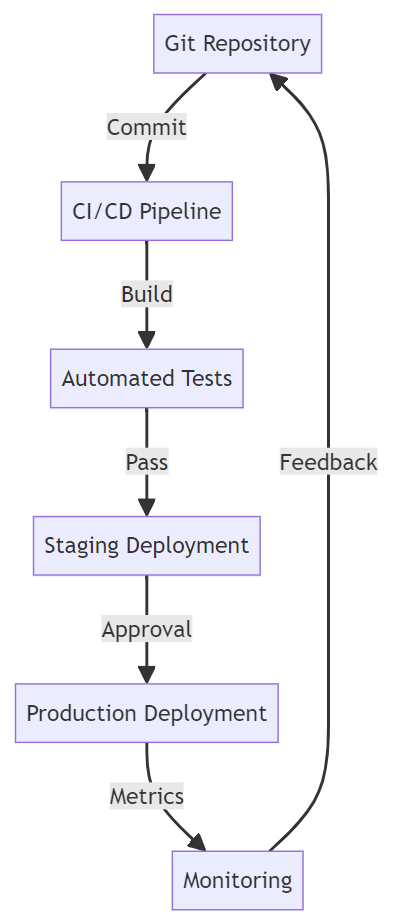
- Version Control Systems: Git for tracking changes and managing code bases.
- CI/CD Tools: Jenkins, GitLab CI, or GitHub Actions for automating build, test, and deployment processes.
- Monitoring Tools: Prometheus, Grafana for tracking system health and performance.
- Workflow Management: JIRA, Trello, or Azure DevOps for managing work items and visualizing flow.
Here’s a simplified example of how these tools might integrate in a VDS:
Engineering for Value
Implementing a Value Delivery System is not just about adopting new tools or processes. It’s about engineering your entire business operation to optimize for value delivery. By focusing on flow, measuring the right metrics, and continuously improving based on feedback, you can create a system that not only meets but exceeds customer expectations.
As software engineers and business leaders, our goal should be to create systems that are as efficient and effective as the code we write. A well-implemented VDS is the key to achieving this, enabling businesses to respond quickly to change, deliver value consistently, and stay ahead in an increasingly competitive landscape.
Remember, the journey to optimizing your Value Delivery System is ongoing. Each iteration brings new insights and opportunities for improvement. Embrace this continuous evolution, and you’ll be well-positioned to deliver exceptional value in an ever-changing business environment. Provide a state diagram illustrating the state transitions.
 DecoupledLogic