AgentOps: The Operational Backbone for AgenticOps
Why agents need their own control plane, and what we’re doing about it.
We’ve spent decades refining how to ship software safely. DevOps gave us version control, CI/CD, monitoring, rollback. Then came MLOps, layering on model registries, drift detection, pipeline orchestration. It’s all good.
But now we’re shipping something different: autonomous agents. Virtual coders that operate alone in their own little sandbox. They are a bunch of mini-me’s that code much better than me. However, they sometimes get lost and don’t know what to do. As a result, they will make things up.
We’re not just shipping code or models, but goal-seeking, tool-using, decision-making alien lifeforms. Beings that reason, reflect, and act. And many are shipping with zero visibility into what they’re doing after launch. I say give them agency but give them guardrails. Trust but verify.
I’ve been enjoying what I’ve been reading on the topic of AgentOps. I’m interested in how to bring valuable practices into our agent development. That’s where AgenticOps comes in. It’s not just DevOps with prompt logging. It’s been a year long thought exercise on how we operationalize agency in production.
What’s so different about autonomous agents?
A few things, actually:
- They improvise. Every agent run can take a new path. Prompts mutate. Goals shift.
- They chain tools and memory. It’s not one model, it’s a process graph across APIs, vectors, scratchpads.
- They’re hard to debug. When something goes wrong, you don’t just check logs. You need to replay reasoning.
- They cost money in real time. An agent stuck in a loop doesn’t just crash, it runs up a token bill that costs real money.
The DevOps playbook wasn’t built for this. Neither was MLOps. This is something new. AgentOps is cool, I love, it but I’ve been calling it AgenticOps and its my playbook.
So what is AgenticOps, really?
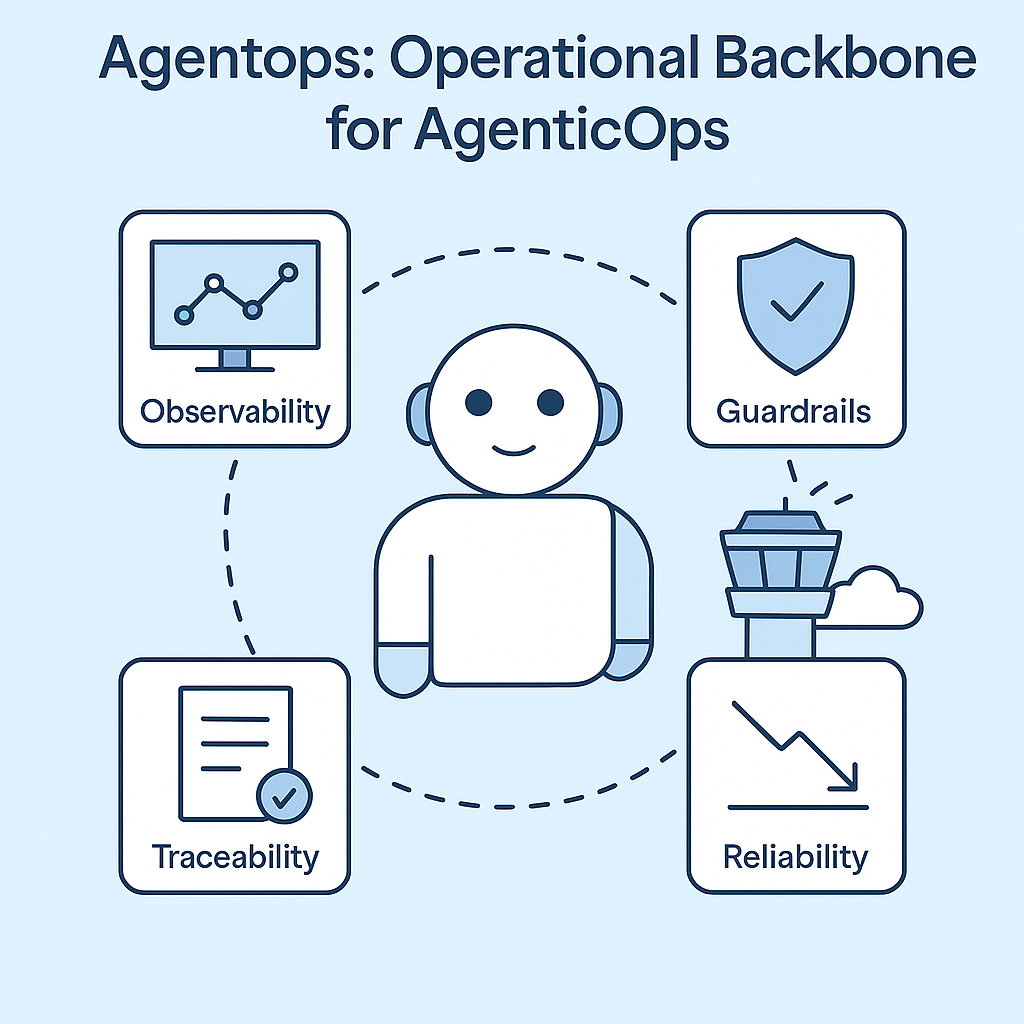
Think of AgenticOps as your mission control tower for autonomous systems. It’s how you keep agency productive, safe, and accountable at scale. These agents are like bad ass kids in a classroom sometimes. My wife is a teacher and she says my agents need routines and rituals and behavior strategies. They need AgenticOps
Here’s what AgenticOps adds to the stack that echoes what I’m seeing in AgentOps:
- Observability for agents
Live dashboards. Step-level traces. Session replays. You see what the agent thought, decided, and did, just like tracing a debugger. - Guardrails that matter
Limit which tools agents can access. Enforce memory policies. Break runaway loops before they eat your GPU budget. - Full traceability
Every prompt, tool call, response, and memory snapshot logged and queryable. Audit trails you can actually follow. - Reliability at runtime
Detect anomalies, hallucinations, cost spikes. Trigger alerts or pause execution if things go sideways.
This isn’t observability-as-a-service tacked onto ChatGPT. This is real operational scaffolding for agentic systems in production.
How it fits into your stack
If your life is shifting into AI Engineering, you’re probably already doing some mix of this:
- Using LangGraph, AutoGen, CrewAI, or your own glue
- Plugging in vector stores, APIs, function calls
- Deploying workflows with multiple agents and tools
An AgenticOps framework encompasses all that. It doesn’t replace it. Instead, it provides a plug-and-play layer to make it safe and visible.
It’s the runtime control layer that lets you:
- Version your agents and context
- Monitor them in action
- Understand what went wrong
- Rewind and fix without guesswork
And just like DevOps before it, AgenticOps will soon be table stakes for any serious deployment.
What you get from AgenticOps
Let’s talk outcomes:
- MTTR down: You can debug reasoning chains like logs. Find the bad prompt in seconds.
- Spend under control: Token usage is monitored and optimized. No more budget black holes.
- Safer autonomy: Guardrails catch weird behavior before it hits production.
- Compliance ready: Trace logs that tell a human story, useful for audits, explainability, and ethics reviews.
This isn’t hypothetical. This is already shipping to production.
Why I care about this
AgenticOps isn’t a buzzword. It’s the foundation that will make agents trustworthy at scale.
If we want autonomous systems to do real work, safely, reliably, transparently, we have to operationalize agency itself.
That’s what we’re building with AgenticOps. It’s our take, our lens, our direction, and how I think in this space.
Let’s talk about it.
If you want to build fast vibe coded prototypes, build alone. If you want to build stable, safe agentic systems for the long-term, build together.
If you’re building “bad ass agents” or agentic systems, I’d love to hear about it. Even if you’re just thinking about it, let me know what you’re running into. Want to play with it and explore together? Let me know. Share your repo and I’ll share mine – https://github.com/charleslbryant/agenticops-value-train.

 Decoupled Logic